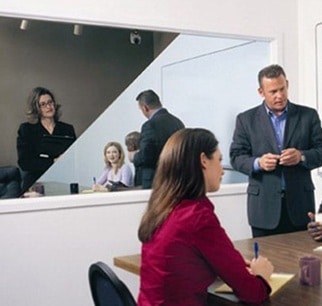
If you’ve ever watched a crime drama movie or TV show, chances are you’ve seen the scene in the interrogation room, where there are detectives interrogating an individual, and there are others standing behind a two-way mirror that the person being interrogated can’t see. These two-way mirrors seem magical, as they appear as a regular mirror when in fact they are transparent from one side and solid from the other. How does this happen? Are they really magical or is there some easy explanation as to how and why two-way mirrors work the way they do?
In order to understand how two-way mirrors work, you first need to understand how they are made and how they differ from traditional one-way mirrors. When a traditional mirror is made, it goes through a silvering process, where a coating of reflective material is applied to the back of a piece of glass. Once this reflective material has been applied, a thin copper layer is applied to prevent oxidation, followed by a layer of paint. This process serves two different purposes: the first is to protect the reflective coating, and the second is to ensure all light is reflected forward to the person standing in front of the mirror, making it impossible to see through a traditional mirror.
During the manufacturing process of a two-way mirror, a thin layer of metal, typically aluminum, is applied to the front of a pane of glass. This layer is so incredibly thin, that only half of the light that hits it is reflected back to what is in front of it, allowing for the rest of the light to pass through the mirror.
The key to two-way mirrors working properly, is for one side of the mirror to be very bright, while the other side is dark. Going back to our police interrogation example, the interrogation room is very bright, while the room on the other side of the mirror where the observers are is dark. When one room is brighter than the other, the light from the interrogation room will reflect back off the surface of the mirror, back into the room, preventing those in the room from being able to see anything other than their own reflections.
The observation room is kept dark so that minimal lighting is transferred back into the interrogation room. Additionally, the large amount of light being transferred from the interrogation side allows those who are observing to see everything that is going on as if they were looking through a tinted window. When the lighting is the same on both sides of the mirror, both sides will be able to see each other.
Aside from being used in interrogation rooms, there are other uses for two-way mirrors, such as teleprompters, scientific and marketing research, security cameras, and the creation of various stage effects for television, movies, and plays.
